PO Greenhouse Film vs PE Greenhouse Film: What Buyers Should Actually Compare
“Is PO greenhouse film better than PE greenhouse film?” sounds like a simple material question. In practice, it is a specification question. The words on the quotation do not tell you enough about the film's optical performance, anti-drip method, outdoor life or suitability for a crop.
There is also a terminology problem. Polyethylene (PE) is itself part of the polyolefin family. In the agricultural film market, however, suppliers often use PO greenhouse film as a commercial label for a higher-function film—commonly a multilayer product with a coated or specially designed inner surface. The exact resin blend and construction can differ between manufacturers.

First: PO and PE are not strictly opposite materials
The International Union of Pure and Applied Chemistry defines a polyolefin as a polymer prepared from an olefin. Polyethylene is produced from ethylene and belongs to this broad family. That scientific definition matters because a buyer should not assume that “PO” means a completely separate material with one fixed formula.
Commercial greenhouse-film language is less precise. In many Asian agricultural markets, “PO film” usually points to a functional greenhouse cover with a multilayer structure and an anti-drip surface treatment. “PE greenhouse film” generally refers to agricultural polyethylene film, which may also be three-layer or five-layer and may include UV stabilizers, anti-drip additives, infrared-retaining additives, diffusion packages or other functions.
The practical comparison
| Buying point | Commercial PO greenhouse film | Agricultural PE greenhouse film |
|---|---|---|
| Material description | A market category rather than one universal resin recipe. Often based on a polyolefin blend in a functional multilayer construction. | Polyethylene-based agricultural film, commonly using LDPE, LLDPE, metallocene PE or compatible copolymers in a supplier-specific blend. |
| Typical construction | Often multilayer, with different layers assigned to weathering, strength, optics and the inner anti-drip surface. | Can be monolayer, but commercial greenhouse grades are often three-layer or five-layer co-extruded films. |
| Anti-drip approach | Frequently promoted with a hydrophilic inner coating that encourages condensation to form a sheet and run toward the sides. | Often uses migrating anti-drip additives; coated PE constructions are also possible. Duration depends on the formulation and use conditions. |
| Light performance | Clear grades can provide high transmission and may be designed to retain surface clarity under condensation. | Clear grades can also exceed 90% transmission. Diffusion, color, thickness, additives, dust and aging all change the measured result. |
| Thermal and diffusion options | Available as project-specific functions; not guaranteed by the PO name alone. | Also available through layer design and additive packages; not limited to basic clear film. |
| Durability | Depends on thickness, UV package, coating care, climate, installation and chemical exposure. | Depends on the same factors. HXT agricultural PE film is specified for 5–10 years in suitable projects and conditions. |
| Color | Clear is common; color can be customized subject to optical and production requirements. | Clear is common; color can also be customized. Any pigment may affect transmission and heat behavior. |
| Cost | Often higher because of coating, multilayer design and functional positioning. | Usually offers a wider range from economical seasonal film to high-function long-life film. |
1. Anti-drip performance is about water behavior, not a slogan
Warm, humid greenhouse air condenses on a colder cover. If the water remains as droplets, it can reduce incoming light and may fall onto the crop. Anti-drip technology reduces surface tension so that condensation spreads into a thin water layer and runs toward the sidewall.
Research on greenhouse cladding has shown that heavy condensation and weak runoff performance can reduce solar transmission, increase humidity and lower daytime temperature inside the greenhouse. This is why anti-drip performance can be commercially important for vegetable, flower and seedling production.
Some PO films use a coated inner face for a more persistent hydrophilic surface. That can be valuable, but it also creates handling requirements: the correct side must face inward, and the coating should not be rubbed or scratched. PE films often use anti-drip agents incorporated into the film. These agents can migrate to the surface over time, and their effectiveness may decline with aging or chemical exposure. Neither method should be accepted without a clear specification and test basis.
2. Do not compare light transmission without the test conditions
Statements such as “90% light transmission” are useful only when the buyer also knows the film thickness, color, test method and whether the result refers to total light, direct light or diffuse light. A thicker or more diffusive film may show a different number without necessarily being worse for the crop.
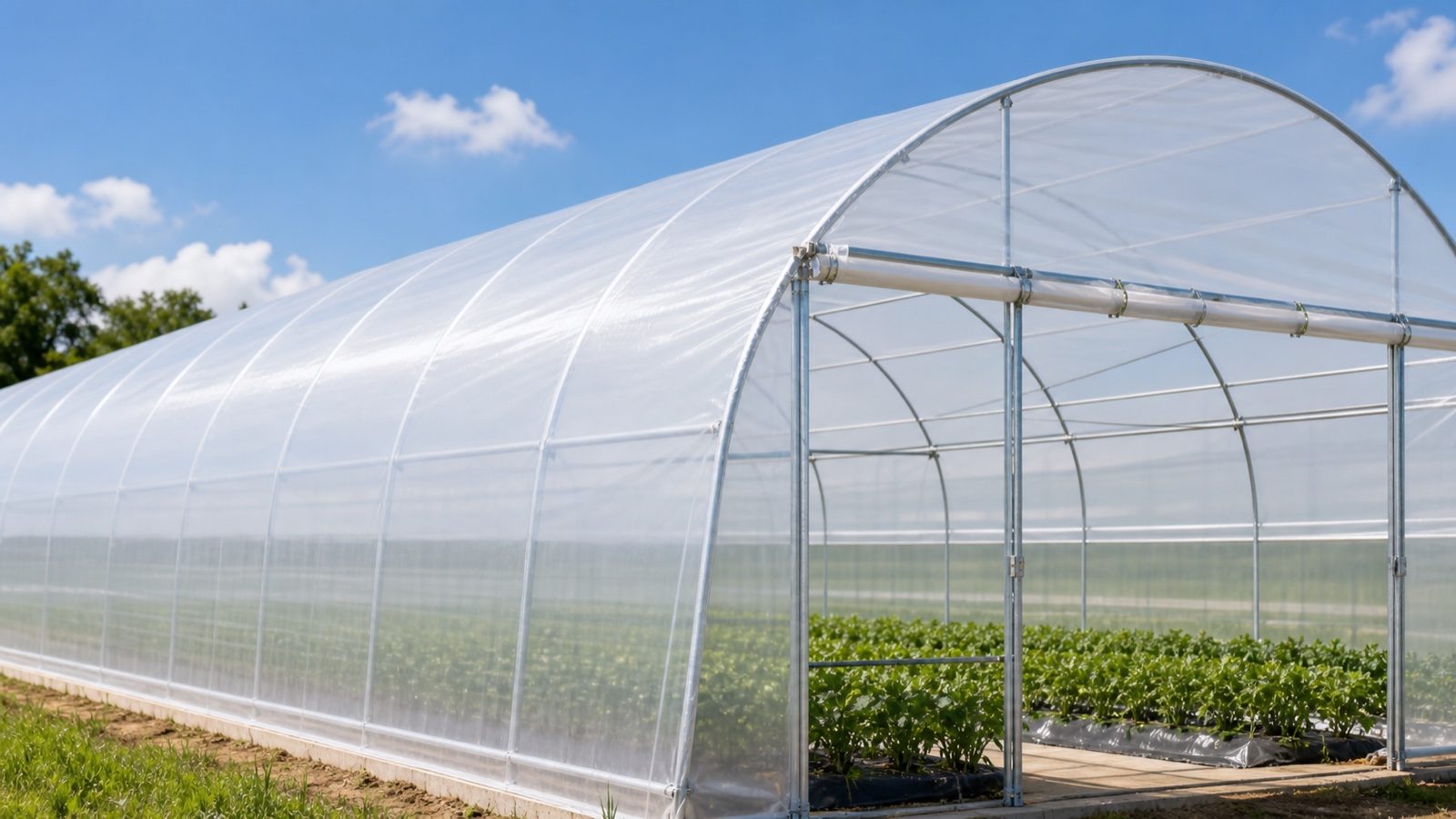
For suitable clear HXT grades, both PO and PE greenhouse film can be configured for 90%+ light transmission. This is not a promise for every thickness or color. Pigments, anti-UV packages, infrared additives, diffusion agents, surface condensation, dust and outdoor aging can all influence the measured value.
For tall crops such as tomatoes, cucumbers and peppers, controlled diffusion may improve light distribution deeper into the canopy and reduce local scorching. In a low-light winter climate, a buyer may instead place greater weight on initial and retained total transmission. The crop and location should decide the optical target.

3. Multilayer does not automatically mean PO
Modern PE greenhouse films are commonly co-extruded in three or five layers. Each layer can serve a different purpose: weather resistance on the outside, mechanical strength in the core, and anti-drip or thermal behavior on the inside. Research comparing multilayer and monolayer polyethylene greenhouse covers has found that a multilayer structure can improve resistance under demanding conditions, but optical results also depend on thickness and construction.
So “multilayer” is a useful engineering detail, but it is not enough by itself. Buyers should request the number of layers, nominal thickness and tolerance, functional layer description, resin policy and production quality-control method.
4. Service life depends on more than the resin name
Outdoor film ages under ultraviolet radiation, heat, wind, repeated temperature changes and mechanical stress. Sulfur- and halogen-containing crop-protection chemicals can also interfere with UV stabilizers and anti-drip systems. Sharp greenhouse frames, excessive tension, rough clips and local heat buildup can shorten life even when the film formula is correct.
This is why a responsible service-life statement must include assumptions. For HXT PE greenhouse film, the available specification is 5–10 years, subject to the selected thickness and UV formulation, destination climate, installation and chemical-use conditions. For PO film, the expected life should be confirmed against the exact project specification rather than copied from a generic PO label.
5. Cost should be calculated per growing cycle
PO greenhouse film often has a higher initial price because the commercial specification may include a coated anti-drip surface and a more complex multilayer design. PE film covers a broader price range and can be economical while still providing long service life and useful optical functions.
The lowest price per kilogram is rarely the best comparison. A buyer should calculate:
- film cost per covered square metre;
- expected replacement interval under local conditions;
- installation and removal labour;
- crop value affected by condensation, light loss or an early film failure;
- freight efficiency, roll dimensions and container loading;
- warranty scope and the evidence required for a claim.
Which film should you choose?
Consider a PO-style higher-function film when:
- persistent anti-drip performance is a primary project requirement;
- the buyer wants a coated inner surface and can follow installation and cleaning instructions;
- crop value justifies a higher initial film cost;
- optical cleanliness under humid greenhouse conditions is closely managed;
- the supplier can provide clear test data for the exact construction.
Consider agricultural PE greenhouse film when:
- you need a practical balance of cost, strength and long outdoor service;
- a three-layer PE construction already meets the required UV, optical and mechanical targets;
- you need flexible thickness, width, color and functional options;
- the project values straightforward replacement planning and broad market acceptance;
- the supplier can match the additive package to climate and crop.
Buyer checklist before requesting a quotation
- Define the greenhouse: structure type, bay dimensions, total covered area and installation method.
- Define the climate: location, UV intensity, temperature range, wind, snow and humidity.
- Define the crop: crop type, season, pollination method and sensitivity to condensation or heat.
- Request the construction: layer count, resin family, coating or additive-based anti-drip method.
- Specify thickness and tolerance: do not accept nominal thickness without a control range.
- Request optical data: total transmission, haze or diffusion, and test method at the quoted thickness and color.
- Confirm durability: UV package, expected service life, warranty terms and excluded chemicals.
- Confirm dimensions: width, roll length, core, folding method, labels and pallet requirements.
- Ask for evidence: sample, production specification, quality-control record and roll traceability.
Final conclusion
PO and PE greenhouse films should not be judged as two simple, opposing resins. PE is a polyolefin, and both product categories can use multilayer structures and functional additives. In commercial purchasing, the more useful distinction is often between a coated higher-function film and an agricultural PE film configured to a specific performance and budget.
A disciplined buyer compares measurable requirements: thickness, tolerance, total and diffuse light, anti-drip method, UV stabilization, chemical limitations, expected life, color and warranty. Once those items are written down, the correct film is usually much easier to identify.
Compare a PO and PE specification for your project
Tell us your crop, greenhouse dimensions, destination, preferred color, thickness, service-life target and required functions. We can organize a practical PO or PE greenhouse film specification before quoting.
View PO greenhouse film View PE greenhouse filmTechnical references
- IUPAC Gold Book: definition of polyolefin
- FAO: Good Agricultural Practices for greenhouse vegetable crops
- Journal of Agricultural Meteorology: effects of condensation on greenhouse-film light transmission
- Polymer Testing: quality evaluation and aging of anti-drop properties
- Polymer Testing: multilayer polyethylene greenhouse films under Saharan conditions
- Mitsubishi Chemical Agri Dream: coated PO greenhouse-film handling guidance