Types of Greenhouses: Which Structure Fits Your Farm?
Choosing a greenhouse is not simply a question of shape. The right structure must suit your crop, climate, available land, expansion plan and operating budget. Roof geometry affects snow shedding and ventilation; frame layout affects usable growing space; and the covering determines light, heat retention and replacement cost.
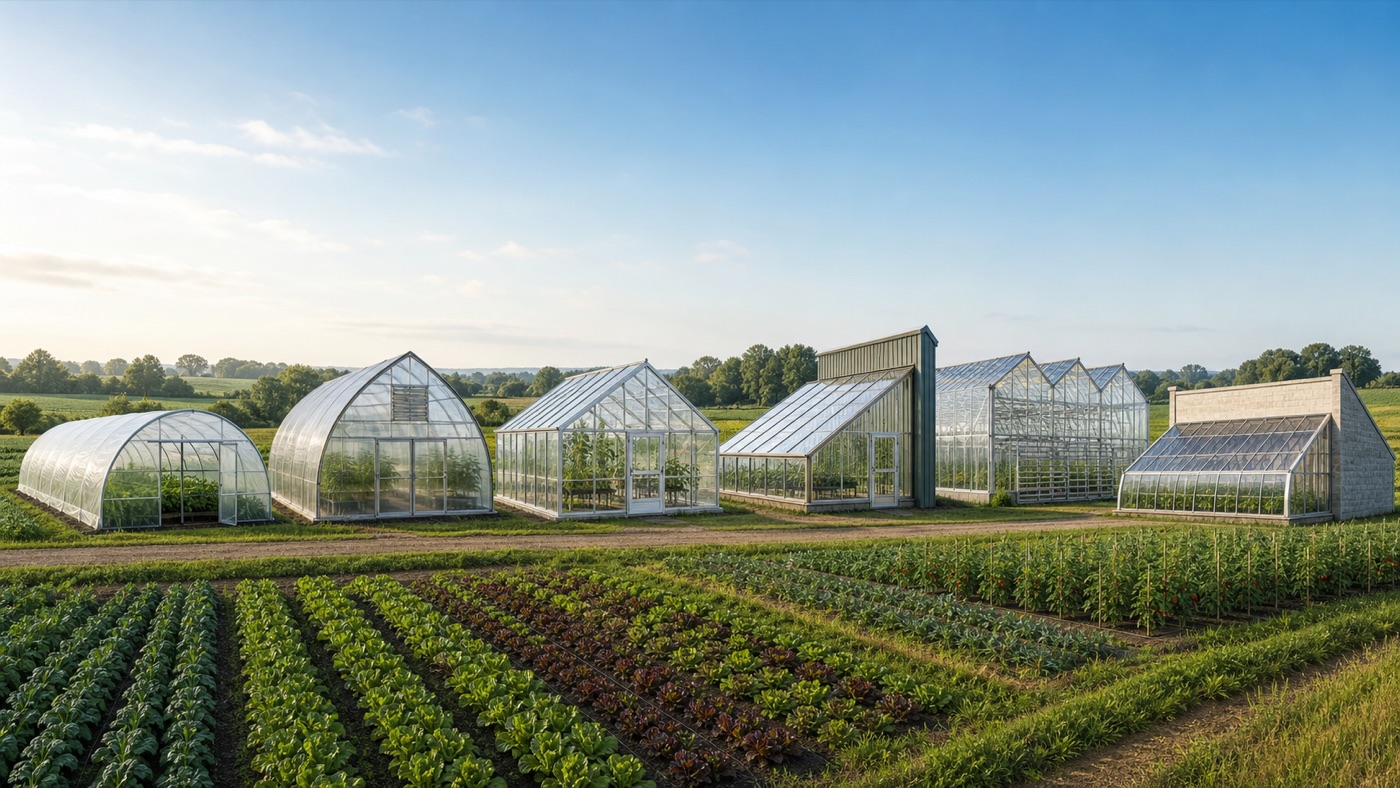
1. Hoop house or Quonset greenhouse
A hoop house uses curved steel tubes covered with flexible greenhouse film. It is one of the most common structures for vegetables, berries, seedlings and seasonal crop protection because the frame is simple, quick to build and easy to extend in length.
Best for: cost-sensitive farms, seasonal production and regions with moderate wind and snow. Watch for: limited sidewall headroom, condensation control and snow accumulation on low roof curves.
2. Gothic arch greenhouse
The Gothic arch is a hoop-house variation with a pointed roof. Its steeper curve improves headroom near the sides and helps rain and snow slide away more easily. The frame and anchoring still need to match local loads; the shape alone does not make a greenhouse storm-proof.
Best for: growers who want economical film covering with stronger snow-shedding geometry. Watch for: reinforced trusses, purlins, anchors and film tension in exposed sites.
3. Gable or traditional greenhouse
A gable greenhouse has straight sidewalls and a pitched roof. The interior is easy to organize, and the straight walls provide good working height for benches, vertical crops and equipment. Glass and rigid polycarbonate are common, but PE film can also be used on suitably designed frames.
Best for: nurseries, research, retail display and long-term installations. Watch for: higher frame and foundation cost compared with a basic hoop house.
4. Sawtooth greenhouse
A sawtooth greenhouse uses repeated roof slopes with raised ventilation openings. Warm air escapes through the high vents while cooler air enters through side openings, creating natural airflow with less dependence on mechanical cooling.
Best for: warm or humid regions and crops that need strong ventilation. Watch for: roof orientation, wind-driven rain, insect-net resistance and whether the vent area remains adequate after screens are installed.
5. Lean-to greenhouse
A lean-to greenhouse shares one wall with a house, warehouse or farm building. It uses little land and may benefit from the adjacent wall's thermal mass and access to utilities. However, the building can block part of the day's sunlight and makes future expansion more difficult.
Best for: propagation, small nurseries, garden centers and limited sites. Watch for: drainage at the connection, building permits and the orientation of the transparent face.
6. Multi-span or Venlo-style greenhouse
Multi-span greenhouses connect several bays under one continuous production area. They use land efficiently, simplify internal logistics and support large irrigation, ventilation and climate-control systems. Their larger enclosed air volume can improve climate stability, but design and construction are more complex.
Best for: commercial vegetable, flower and nursery operations planning long-term scale. Watch for: gutter drainage, structural engineering, ventilation ratio and the cost of cooling a wide block.
7. Chinese passive-solar greenhouse
This design normally uses a heavy north wall and side walls for thermal storage, with a transparent south-facing roof. The wall absorbs solar heat during the day and releases it after sunset; an insulating curtain may cover the roof at night. It can reduce winter heating demand in cold, sunny regions.
Best for: winter vegetable production where sunshine is reliable and heating fuel is expensive. Watch for: correct solar orientation, shading at the ends, moisture management and a structure that is harder to scale into wide connected blocks.
8. Pit greenhouse or Walipini
A pit greenhouse is built partly below ground to use the soil's relatively stable temperature. It can reduce heat loss in suitable dry locations, but it is not automatically a low-cost solution. Drainage, retaining walls, waterproofing and safe access are critical.
Best for: small projects in dry climates with suitable soil and water tables. Watch for: flooding, poor low-angle light, humidity and engineering requirements.
Greenhouse types at a glance
| Type | Main strength | Main limitation | Typical scale |
|---|---|---|---|
| Hoop / Quonset | Low cost and quick installation | Lower side headroom; moderate load capacity | Small to commercial single-span |
| Gothic arch | Better snow shedding than a low hoop | Needs carefully formed frames and bracing | Small to medium commercial |
| Gable | Excellent usable interior space | Higher frame and foundation cost | Nursery to commercial |
| Sawtooth | Strong natural ventilation | More complex roof detailing | Medium to large commercial |
| Lean-to | Saves land and shares utilities | Limited light and expansion | Hobby to small commercial |
| Multi-span | Efficient land use and logistics | Higher investment and climate complexity | Large commercial |
| Chinese solar | Lower winter heating demand | Orientation-dependent and less flexible | Small to commercial single-span |
| Pit / Walipini | Uses ground temperature | Drainage and light can be difficult | Small specialty projects |
How to choose the right greenhouse
Start with the local environment, then work inward toward the crop. A good purchasing brief should answer these questions before frame or film quotations are compared:
- Climate: maximum wind speed, snow load, rainfall, hail, temperature range and solar radiation.
- Crop: plant height, season, target temperature, humidity tolerance and light requirement.
- Ventilation: natural side and roof vents, forced fans, insect screens and evaporative cooling.
- Operation: machinery access, bench layout, irrigation, worker movement and crop rotation.
- Expansion: whether more bays or longer houses may be added later.
- Permits: local foundation, building, fire and property requirements.
Match the covering film to the structure
The frame and covering must be specified as one system. Flexible PE greenhouse film is especially practical for hoop, Gothic arch, sawtooth and many multi-span structures. Buyers should not select film by price per kilogram alone. Confirm:
- finished width and roll length for the actual roof geometry;
- thickness and thickness tolerance;
- UV package matched to location and expected service life;
- light transmission and diffusion requirements;
- anti-drip, anti-fog, thermal or infrared-retention functions;
- film fixing method, wind exposure and replacement labor.
A low-cost structure can become expensive if its film needs frequent replacement. In the same way, a premium film cannot compensate for poor anchoring, sharp frame edges or inadequate ventilation.
Frequently asked questions
What is the most economical greenhouse type?
A single-span hoop house is usually the lowest-cost practical option because its curved frame is simple and PE film provides a lightweight covering.
Which greenhouse type is better for snow?
A properly engineered Gothic arch or steep gable greenhouse usually sheds snow better than a low round hoop. Always use local structural calculations rather than choosing by appearance alone.
Which greenhouse is best for hot climates?
Open-sided hoop houses and sawtooth greenhouses are common choices where natural ventilation is the main priority. Vent area, orientation and insect netting all affect real airflow.
Final recommendation
There is no universal “best” greenhouse. For many growers, the best choice is the simplest structure that safely handles local weather, gives the crop enough light and ventilation, and can be maintained without excessive labor. Compare total ownership cost—not just the initial frame price—and specify the covering at the same time as the structure.
Further reading: Dave's Garden overview of greenhouse styles. This HXT guide was independently written for agricultural buyers and commercial growers.
Choosing film for a greenhouse project?
Tell us the greenhouse type, roof width, crop, destination climate and expected service life. We can help you prepare a practical PE greenhouse film specification.
View PE greenhouse film