Where Do Buyers Import Weed Control Fabric From—and What Should They Check?
International buyers often begin with a country question: should woven weed control fabric come from China, India, Türkiye or a European supplier? The question is reasonable, but it is incomplete. Country of origin can indicate manufacturing scale, logistics and price structure. It cannot prove the material, UV package, roll tolerance or consistency of the goods that will arrive.
A better sourcing process uses the country as a first filter, then moves quickly to measurable specifications, factory capability, sample control, inspection and total landed cost.
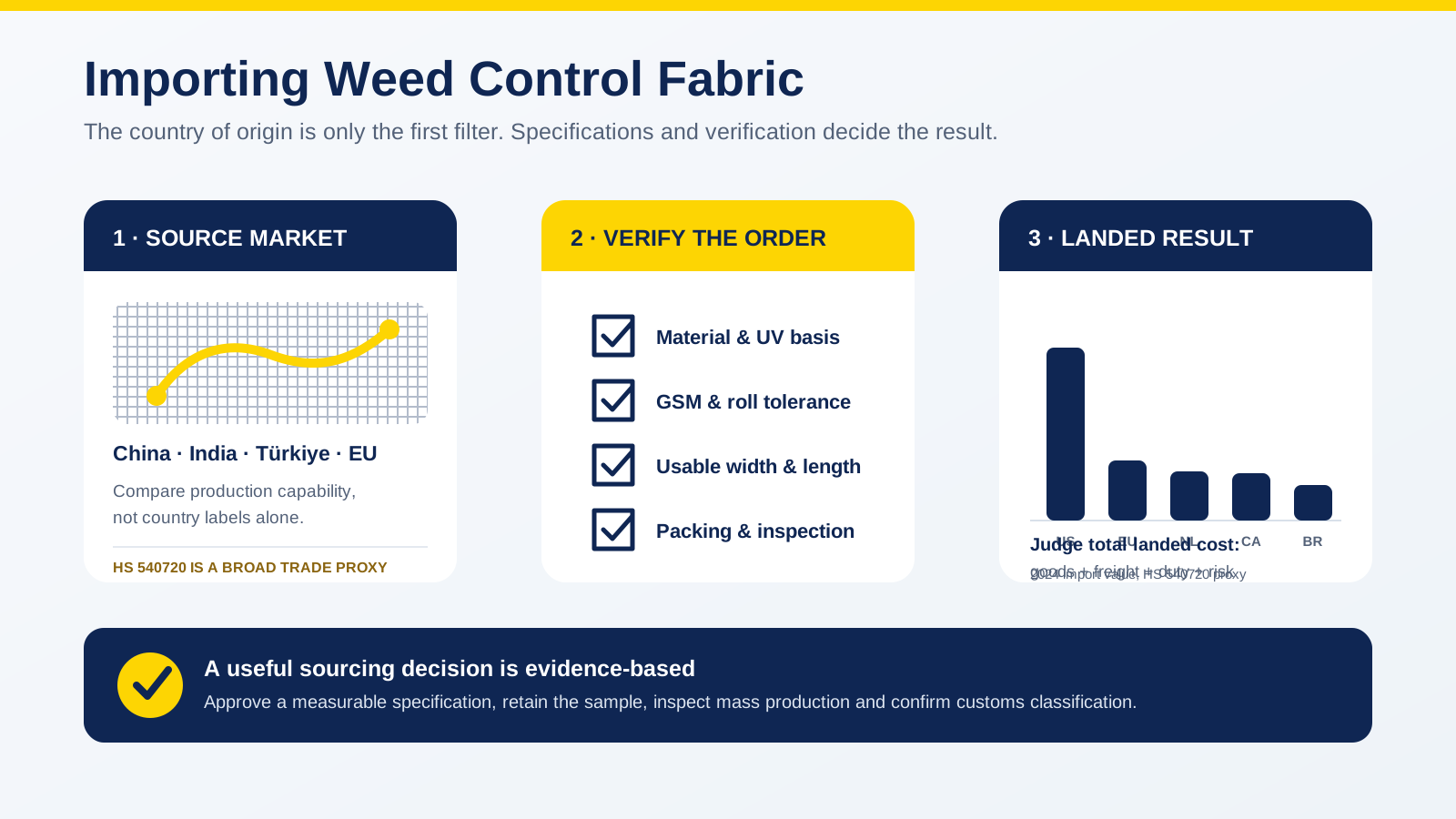
First, understand the limit of the trade data
Woven PE or PP ground-cover products are often discussed under HS 540720, “woven fabrics obtained from synthetic strip or the like.” This is useful for observing broad trade patterns, but it is not a weed-control-fabric-only category. It can contain other woven synthetic-strip fabrics, and final customs classification may change with material, coating, construction and the rules of the importing country.
For that reason, the figures below should be read as a market proxy—not as a precise statement of weed-mat sales. Before shipment, the importer should give the product description, composition and construction to a customs broker and confirm the destination-country code, duty and documentation.
Which countries supply woven synthetic-strip fabric?
World Bank WITS data based on UN Comtrade reports the following leading exporters for HS 540720 in 2024:
| Exporter | 2024 export value | Reported quantity |
|---|---|---|
| China | US$264.8 million | 129.9 million kg |
| India | US$130.2 million | 33.5 million kg |
| European Union | US$127.0 million | 23.5 million kg |
| Saudi Arabia | US$114.7 million | 48.1 million kg |
| Türkiye | US$75.3 million | 30.7 million kg |
The ranking shows that buyers have several serious sourcing regions. It does not show which one is automatically “best.” A distributor may value short European lead times and local stock. A large-volume private-label importer may value China’s manufacturing depth and customization. Another buyer may already have a reliable regional supplier whose consistency outweighs a lower overseas quotation.
Where is import demand concentrated?
The same broad 2024 data places the United States first among importers, followed by the European Union as an aggregate market. The Netherlands, Canada and Brazil are also prominent, with France, Germany, Poland, Japan, the United Kingdom and Australia forming substantial individual markets.
This pattern is useful to manufacturers because it suggests demand across several buyer types: agricultural distributors, horticultural and nursery suppliers, landscape channels, project contractors and private-label wholesalers. Yet a high national import value does not mean every buyer wants the same product. Orchard floors, nursery container areas, vegetable rows and retail landscape rolls require different widths, weights, line markings and packaging.
Why do many importers source from China?
China’s advantage is not one isolated low price. It is the ability to connect resin processing, tape extrusion, weaving, lamination or finishing, cutting, sewing, printing, roll packing and container loading at commercial scale. This can support a wide range of GSM, widths, roll lengths, colors, guide lines and private-label packaging.
That flexibility matters when an importer needs more than a generic black roll. A nursery distributor may need pedestrian-safe widths and pallet plans. An orchard program may need long rolls to reduce joins. A retail customer may need barcodes, labels and smaller rolls. Manufacturing depth makes these variations possible, but every variation must still be written into the order specification.
Why can Weifang, Shandong be a practical sourcing base?
Weifang’s strongest argument is not that every supplier there is better. The advantage is the surrounding agricultural and manufacturing ecosystem.
1. Products are close to real agricultural use
Weifang includes Shouguang, a nationally recognized center for intensive vegetable and protected agriculture. Xinhua describes Shouguang as the “hometown of vegetables in China” and the birthplace of winter-warm greenhouses. It also reports that more than 30 Shouguang enterprises and cooperatives have expanded overseas and established more than 300 cultivation parks.
This does not certify a roll of fabric. It does mean that ground covers, greenhouse films, irrigation systems and related agricultural materials are discussed near professional users. Problems involving drainage, anchoring, field traffic, crop layout and installation are easier to see than in a manufacturing cluster with no agricultural demand around it.
2. Related products can be reviewed together
Importers frequently buy a program rather than one isolated item: woven ground cover, reflective cover, greenhouse film, shade material, insulation covers, drip tape and fittings. A regional agricultural supply base can reduce the communication distance between these categories and make mixed-product development or container planning more practical.
3. Qingdao provides broad export connectivity
Shandong manufacturers can route export cargo through Qingdao. In February 2026, the Qingdao municipal government reported that Qingdao Port had nearly 240 foreign-trade routes connecting more than 700 ports in over 180 countries and regions. This does not remove inland haulage or freight volatility, but it gives Weifang exporters access to a major international container network.
4. Factory communication can stay close to production
For customized ground cover, buyers need quick answers from extrusion, weaving, finishing and packing—not only from a sales desk. A factory-direct relationship can shorten the path between a revised specification and the production team. The benefit exists only when the seller is transparent about what is made in-house and what is subcontracted.
Seven common traps when importing weed control fabric
1. Comparing only price per square meter
A low unit price can hide lower actual GSM, shorter rolls, narrow usable width, weaker UV stabilization or inefficient packing. Compare an agreed specification and landed cost.
2. Treating nominal GSM as a full standard
Write the test method, sampling method and tolerance. One small cut sample cannot represent the average of a full production roll or batch.
3. Using “PP” and “PE” loosely
Confirm the polymer and construction in writing. Do not rely on a marketplace title, color or surface appearance to identify the material.
4. Accepting an undefined UV claim
“UV treated” is not a complete specification. Ask what additive basis, test, exposure condition or warranty supports the statement, and remember that climate and installation affect service life.
5. Ignoring roll geometry
Confirm usable width, roll length, core, roll diameter, net and gross weight, pallet dimensions and rolls per container. These details affect field coverage and freight.
6. Approving a sample but not controlling production
Sign and retain the approved sample and data sheet. Require pre-shipment inspection against the same measurable criteria before the balance is released.
7. Copying an HS code from another shipment
Classification and duty can vary by destination and exact product. Confirm the code with the importer’s customs adviser before final costing and labeling.
8. Forgetting destination charges
Freight is only one line. Include duty, customs clearance, port and terminal charges, delivery, insurance, inspection and financing time in the landed-cost comparison.
A practical RFQ and inspection checklist
A useful request for quotation should define:
- polymer and product construction;
- color, guide-line color and line spacing;
- target GSM, tolerance and test method;
- usable width, roll length and allowable variation;
- weave density, tensile or tear requirements where relevant;
- water permeability or drainage expectation;
- UV requirement and the basis for any service-life claim;
- roll core, wrapping, label, pallet and container-loading plan;
- approved sample, batch identification and inspection level;
- Incoterm, loading port, lead time and required export documents.
For a new supplier, begin with samples that represent the intended construction, then use a controlled trial or smaller first order when practical. Before shipment, inspect roll count, dimensions, weight, appearance, labels, packing and selected physical properties. A clear acceptance rule is more useful than a promise to “keep good quality.”
How should a buyer decide where to import from?
The best source is the one that can repeatedly meet the required specification at an acceptable total cost and risk. Geography matters because it shapes manufacturing capability, lead time and logistics. It should not replace verification.
Weifang can be a strong choice for agricultural ground cover because it combines a specialized plastics base, nearby intensive agriculture, access to related product categories and practical export routes through Qingdao. But the disciplined conclusion is simple: a regional advantage creates opportunity; samples, records and inspection turn that opportunity into a reliable order.
Comparing woven ground cover suppliers?
HXT Plastics manufactures PE woven weed barrier in Weifang with customizable GSM, 1–8 m widths, roll lengths, guide lines and OEM packing. Send your current data sheet or sample so the construction and loading plan can be compared on the same basis.
View PE Woven Weed BarrierData sources and further reading
- World Bank WITS / UN Comtrade — 2024 exporters of HS 540720
- World Bank WITS / UN Comtrade — 2024 importers of HS 540720
- Xinhua / Belt and Road Portal — Shouguang agricultural technology and overseas projects
- Qingdao Municipal Government — Qingdao Port foreign-trade route network, February 2026
Method note: HS 540720 is used here only as a broad proxy for woven synthetic-strip fabric. It is not a weed-control-fabric-only category, and it should not be copied as the final customs classification for a specific shipment without professional review.