How to Choose Drip Tape: Emitter Spacing, Wall Thickness and Diameter
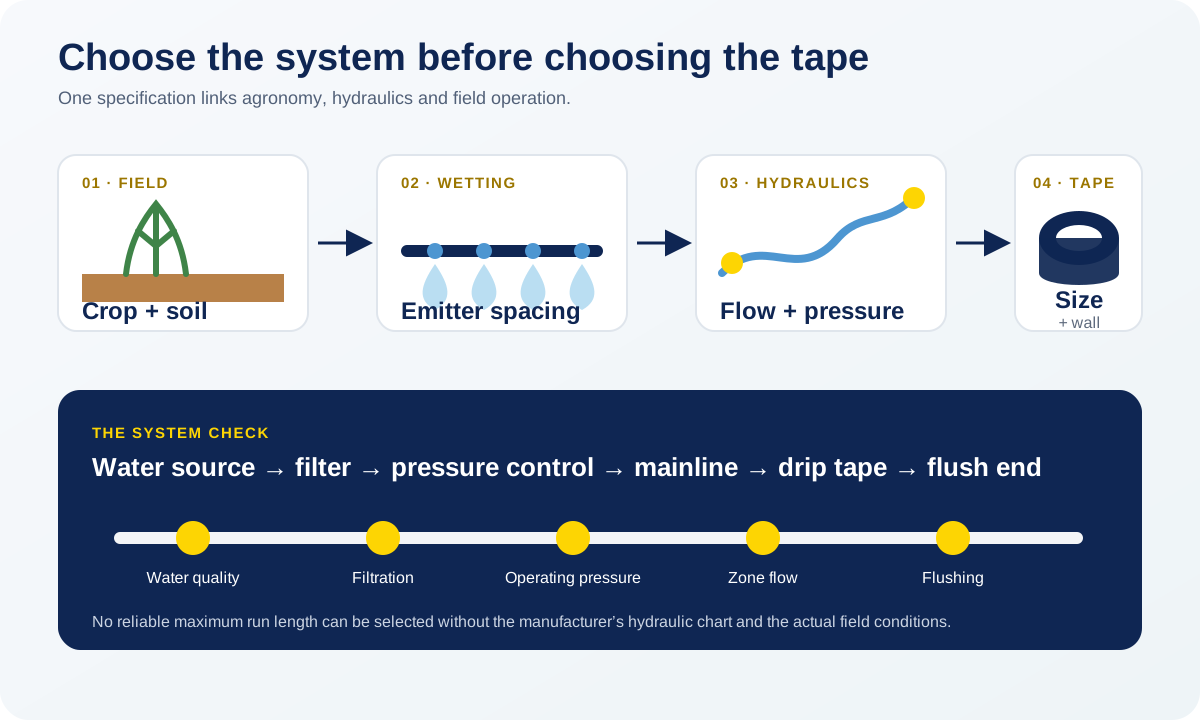
A roll of drip tape is easy to describe. Choosing the right one is not. Diameter, wall thickness, emitter spacing and flow rate are connected; a change in one part affects pressure loss, zone flow, wetting pattern, pump demand and sometimes the cost of the whole system.
This is why a useful specification begins with the field rather than the catalog. Crop spacing, soil texture, row length, elevation, water quality and the planned irrigation time should be known before a buyer decides between 16, 20 or 22 mm tape.
Why these four questions appear so often
Online searches around drip tape repeatedly return the same practical concerns: emitter spacing, wall thickness, tape size, maximum run length, installation, fittings and clogging. They are all versions of one question: “Will this tape apply water evenly in my field?”
There is no honest universal answer based on tape size alone. Penn State Extension identifies flow rate, emitter spacing, wall thickness, diameter and pressure behavior as the central selection variables. The University of Minnesota adds crop spacing, soil behavior and pressure regulation to the same decision. These are useful principles because they begin with irrigation performance, not with a product label.
1. Begin with crop, soil and field geometry
Before comparing rolls, prepare a simple field brief:
- crop and planting pattern;
- row spacing, row length and number of rows per irrigation zone;
- soil texture and, if possible, an observed wetting test;
- elevation change from the first to the last emitter;
- water source, available flow and pressure;
- water analysis or at least known sand, hardness and biological risks;
- surface, under-mulch or shallow subsurface installation;
- target irrigation duration and expected service period.
This information is more valuable than asking only for a price per roll. It allows the tape, filter, regulator, mainline and zone size to be considered together.
2. Emitter spacing follows the wetting pattern—not a single rule
Emitter spacing is the distance between water outlets along the tape. A common mistake is to make it equal to plant spacing automatically. That can work for widely spaced plants when each emitter serves a plant, but many row crops are irrigated as a continuous wetted strip. In that case, soil movement matters as much as plant position.
Sandy soils usually move water downward faster and sideways less. Closer emitters can help avoid dry gaps. Loam and clay soils often spread water farther laterally, so a wider spacing may still form a continuous wetting pattern. The University of Minnesota therefore recommends testing spacing in the actual soil, especially where sand content is high.
Closer spacing may suit
Sandy soil, closely planted vegetables, germination beds or situations where a continuous wetted strip must develop quickly.
Wider spacing may suit
Soils with stronger lateral movement, wider plant spacing or lower total zone-flow targets—provided a field test shows no dry gaps.
Closer spacing also increases the number of emitters per meter. At the same emitter discharge, total tape flow rises. The pump, mainline, filter and pressure regulator must then support a larger zone flow.
3. Flow rate determines both irrigation time and system demand
Drip tape may be described by flow per emitter or by flow per unit length at a stated test pressure. These numbers are not interchangeable unless emitter spacing and pressure are also known.
A higher-flow tape may shorten irrigation time, but it also increases pressure loss and the required pump, filter and mainline capacity. A low-flow tape can reduce instantaneous demand, yet may require a longer irrigation set. The better choice is the one that delivers the target water depth within the available operating window while keeping acceptable uniformity.
4. Diameter is a hydraulic choice: 16, 20 or 22 mm
Diameter influences the space available for water to move through the tape. As lateral length and total lateral flow increase, friction loss becomes more important. A larger diameter can reduce that loss in some designs, but it is not automatically the correct or most economical option.
- 16 mm: a common starting point for many shorter and medium-length row-crop laterals.
- 20 mm: may be considered where lateral length or flow demand increases.
- 22 mm: may be useful for selected longer or higher-flow layouts, subject to the hydraulic chart and compatible fittings.
Maximum run length cannot be stated responsibly without the emitter model, spacing, inlet pressure, flow rate, elevation and permitted discharge variation. Two tapes with the same nominal diameter may behave differently because their emitter and flow-path designs differ.
5. Wall thickness is about risk and service—not water output
Wall thickness affects handling, puncture resistance, cost and possible service life. It does not by itself prove better irrigation uniformity. A thinner tape can be appropriate for a carefully managed seasonal crop; a heavier wall may be justified where installation, insects, animals, machinery, stones or retrieval create more mechanical risk.
Penn State notes that wall choice should consider the number of seasons and the potential for damage. That is a more useful method than assuming that the thickest tape is always best. Water quality can end service before the wall fails, so filtration and maintenance often matter as much as extra material.
6. Filtration, pressure control and flushing are not accessories
Drip emitters contain narrow flow passages. Sand, suspended solids, biological growth and mineral precipitation can reduce discharge or block them. University of Florida guidance treats filtration and routine flushing as core parts of clogging control.
A basic system normally runs from the water source through pumping, filtration and pressure regulation to the mainline, take-off valves, drip tape laterals and flush ends. The filter must match both the water source and the emitter requirement. The pressure regulator must match the operating flow range—not merely a familiar pressure number.
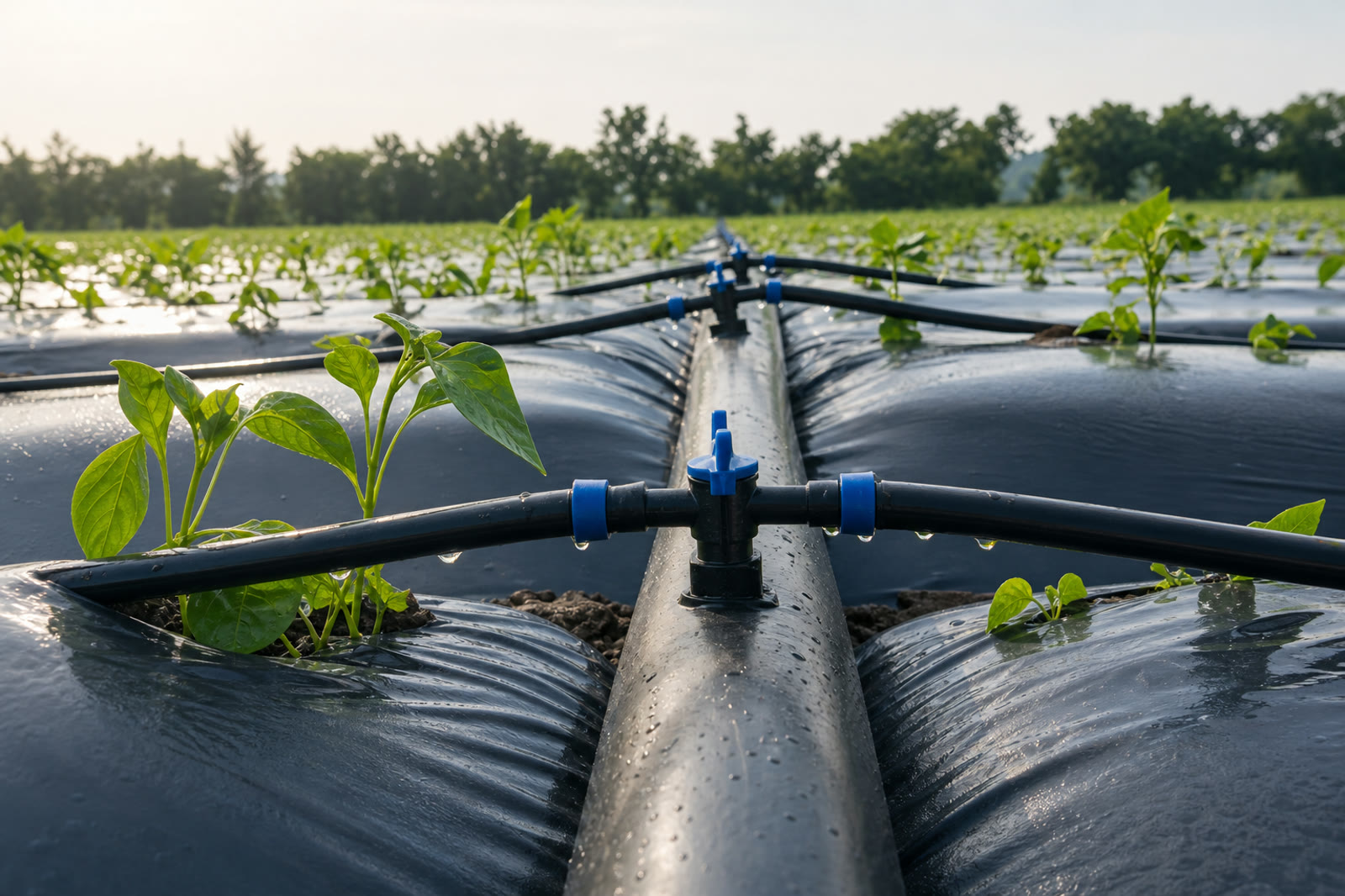
A field system is only as reliable as the match between tape, fittings, filtration, pressure and installation.
7. A practical specification checklist for buyers
When requesting a quotation or sample, send the following information together:
- crop, soil type and planting layout;
- field drawing with row length, row count and elevation;
- water source, available pressure and flow;
- required diameter: 16, 20 or 22 mm, if already calculated;
- emitter spacing and target emitter flow;
- wall thickness and roll length;
- surface, mulch or subsurface installation;
- required take-off valves, connectors, end closures and punch tools;
- packing, pallet and private-label requirements.
If some values are unknown, leave them open and provide the field data instead. A responsible supplier should explain which assumptions were used rather than filling every blank with the largest available specification.
Common questions
Should emitter spacing equal plant spacing?
Not always. It may match individual plants, but for many row crops the goal is a continuous wetted strip. Crop geometry, root zone and soil lateral movement should be considered together.
Is a larger drip tape diameter always better?
No. A larger diameter may reduce friction loss in longer or higher-flow laterals, but it also affects cost and fitting compatibility. Use the hydraulic chart and actual field conditions.
Can one maximum run length be used for every field?
No. Maximum length changes with diameter, emitter flow and spacing, inlet pressure, elevation and acceptable variation between the first and last emitter.
What causes drip tape to clog?
Physical particles, biological material and chemical precipitation are common causes. Water analysis, correct filtration, line flushing and suitable water treatment are the starting controls.
A restrained conclusion
Good drip tape selection is not a contest between bigger and smaller specifications. It is an exercise in balance. The right tape is the one that forms the intended wetting pattern, operates within the available pressure and flow, survives the planned field work and can be maintained with the actual water source.
When those conditions are clear, diameter, wall thickness, emitter spacing and fittings become easier to specify—and easier to verify before a large order is placed.
Preparing a drip tape specification?
HXT supplies 16, 20 and 22 mm drip tape with customizable emitter spacing, wall thickness, roll length and matched fittings. Send the field drawing and water conditions so the configuration can be reviewed before production.
View Drip Tape & Fittings